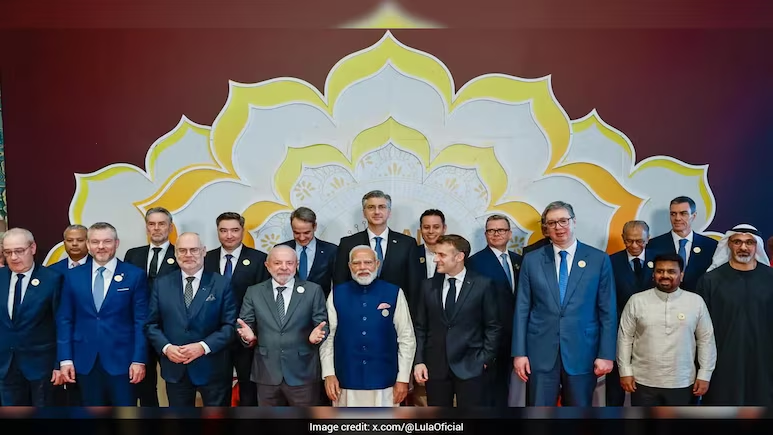
The Lula India state visit has arrived with significant momentum. Consequently, Brazil’s president brings the largest-ever business delegation abroad. Furthermore, over 260 companies and 14 cabinet ministers accompany him. Thus, trade and economic cooperation anchor this bilateral engagement. This strategic timing aligns with shifting global trade dynamics.
Specifically, the visit coincides with the AI Impact Summit in New Delhi. Therefore, technology cooperation emerges as a new relationship dimension. Moreover, Lula addressed digital infrastructure and inclusive growth topics. Consequently, artificial intelligence partnerships gain practical focus. The Lula India state visit thus expands beyond traditional commerce.
Bilateral talks with Prime Minister Narendra Modi are scheduled for February 21. Specifically, discussions will review the entire gamut of relations. Additionally, trade, investment, energy, and defence cooperation feature prominently. Furthermore, digital technologies and people-to-people links receive attention. Therefore, the Lula India state visit promises comprehensive outcomes.
Regional and global issues will also shape dialogue notably. Consequently, multilateral forum cooperation remains a priority topic. Moreover, reformed multilateralism and Global South concerns feature centrally. Thus, shared democratic values guide strategic convergence. This alignment strengthens both nations’ international influence effectively.
Trade expansion drives the core agenda significantly. Specifically, protectionist measures from Washington create new partnership incentives. Therefore, Brazilian officials view India as a key diversification partner. Moreover, South-South cooperation gains practical momentum through this engagement. Consequently, the Lula India state visit addresses global supply chain reconfiguration.
Record delegation size reflects Brasilia’s commercial ambitions clearly. Specifically, this push deepens ties with New Delhi strategically. Furthermore, global trade uncertainties make this timing particularly relevant. Thus, both capitals see mutual benefit in closer economic integration. The Lula India state visit thus catalyzes tangible business opportunities.
India and Brazil share diplomatic relations established in 1948. Consequently, their Strategic Partnership since 2006 rests on shared values. Additionally, inclusive development visions unite both nations’ policy approaches. Therefore, frequent high-level interactions reflect growing strategic convergence naturally. This foundation supports the current Lula India state visit outcomes.
Lula previously visited India for the 2023 G20 Summit. Specifically, engagement has intensified significantly since that meeting. Moreover, Prime Minister Modi’s July 2025 Brasilia visit marked a milestone. That trip established a trade ministers’ review mechanism notably. Furthermore, leaders set a USD 20 billion bilateral trade target for 2030.
Bilateral trade already demonstrates strong upward momentum effectively. Specifically, 2025 calendar year trade reached $15.21 billion. Consequently, this represents over 25 percent growth year-over-year. Indian exports stood at $8.35 billion during this period. Additionally, imports from Brazil totaled $6.85 billion significantly. Therefore, the Lula India state visit builds upon existing commercial success.
Indian investments in Brazil exceed $15 billion currently. Specifically, these span energy, pharmaceuticals, IT, and manufacturing sectors. Consequently, economic interdependence deepens through diversified portfolio allocation. Moreover, this capital flow supports job creation in both nations. Thus, mutual prosperity anchors the bilateral relationship sustainably.
Energy cooperation features prominently in scheduled discussions notably. Specifically, Brazil serves as India’s largest upstream investment destination in the Americas. Furthermore, biofuel partnerships gain strategic importance through the Global Biofuel Alliance. Consequently, crude oil supply chains strengthen bilateral trade volumes. Therefore, the Lula India state visit advances clean energy collaboration.
Defence and security ties have expanded steadily over time. Specifically, the 2003 defence cooperation agreement laid institutional foundations. Moreover, Joint Defence Committee meetings facilitate regular strategic dialogue. Additionally, armed forces exchanges and joint training initiatives increase operational compatibility. Thus, Scorpene-class submarine collaboration exemplifies practical defence partnership.
Digital technology forms another fast-growing relationship pillar significantly. Specifically, the IndiaStack cooperation agreement enables digital infrastructure collaboration. Consequently, payment systems like UPI and Brazil’s PIX gain interoperability potential. Furthermore, artificial intelligence training programmes and semiconductor partnerships emerge. Therefore, innovation ecosystems benefit from this strategic knowledge exchange.
Parliamentary, judicial, and people-to-people exchanges add partnership depth. Specifically, the Indian diaspora in Brazil numbers around 4,000 individuals. Moreover, this community contributes actively to business and technology sectors. Consequently, cultural understanding supports broader economic cooperation effectively. Thus, soft power dimensions complement formal government engagements.
Global trade uncertainties persist across multiple regions currently. Therefore, New Delhi and Brasilia view closer cooperation as mutually beneficial. Furthermore, strengthening the Global South voice remains a shared priority. Consequently, balanced international order objectives guide strategic alignment. The Lula India state visit thus advances inclusive governance principles.
Political goodwill requires translation into concrete economic outcomes. Specifically, actionable agreements will define visit success metrics. Moreover, implementation mechanisms ensure follow-through on announced commitments. Therefore, monitoring frameworks track progress transparently over time. Additionally, stakeholder feedback loops refine partnership effectiveness continuously.
Sustainable partnership growth depends on adaptive management practices. Consequently, regular review mechanisms adjust strategies to evolving conditions. Furthermore, emerging challenges receive collaborative problem-solving attention. Thus, resilience characterizes the bilateral relationship long-term. Additionally, shared learning accelerates mutual development outcomes effectively.
Measurable outcomes will validate strategic choices over time. Specifically, trade volume growth indicates commercial integration success. Moreover, investment flow trends reflect confidence in partnership stability. Thus, tracking these metrics informs future policy adjustments. Additionally, qualitative assessments capture relationship depth beyond quantitative indicators.
Ultimately, the Lula India state visit represents strategic foresight. Therefore, both nations position themselves for multipolar global dynamics. Furthermore, South-South cooperation models offer alternatives to traditional frameworks. Thus, inclusive development principles guide economic engagement. Consequently, this partnership strengthens democratic resilience globally.
Commitment to balanced growth defines this bilateral approach. Therefore, policy coordination supports sustainable development objectives. Furthermore, innovation ecosystems benefit from cross-border knowledge sharing. Thus, the Lula India state visit catalyzes long-term prosperity. Shared vision powers collaborative progress effectively.
READ: Mexico Launches 30% Tax Incentive for Film with Salma Hayek’s Support