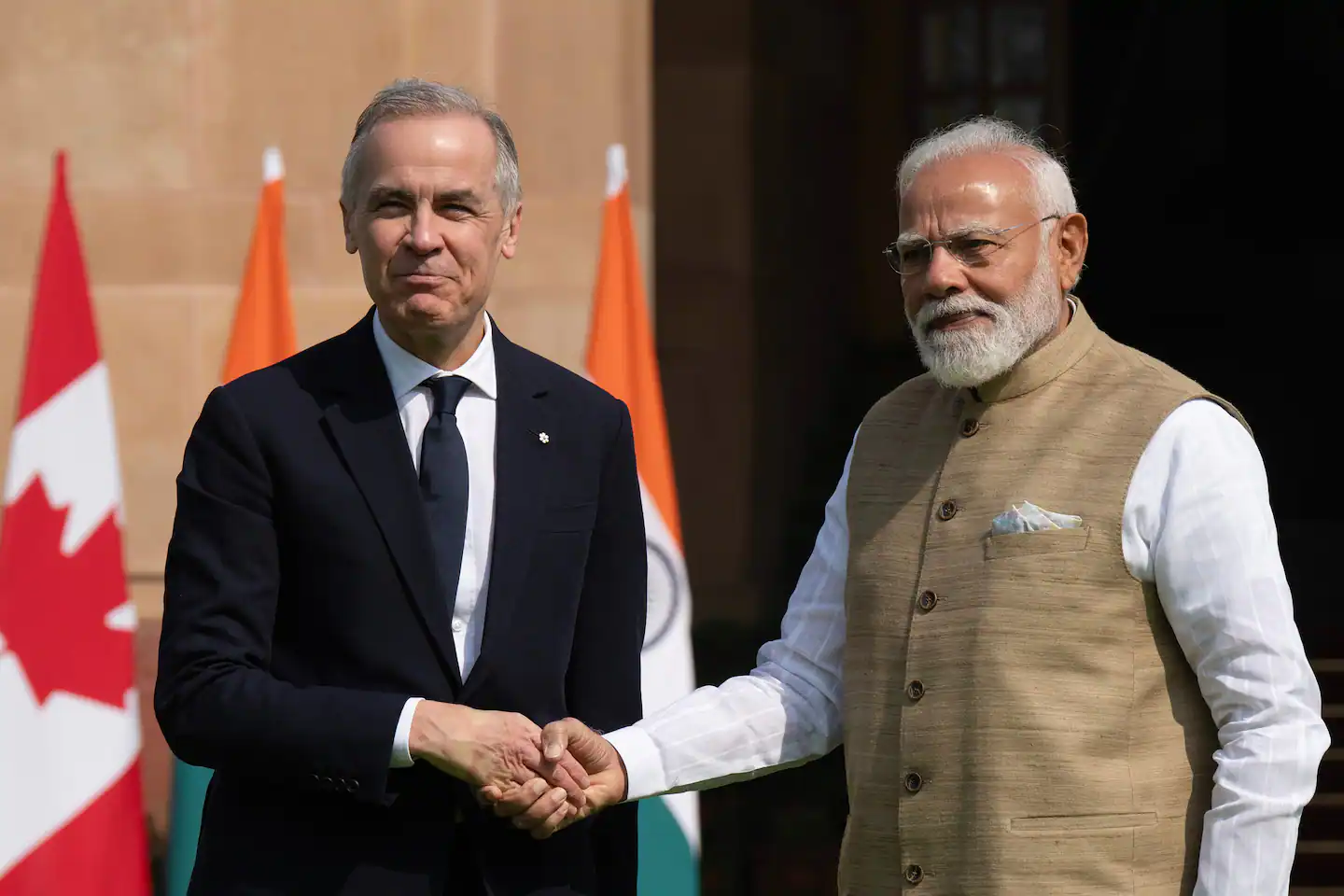
The India Canada economic partnership is set for a renewed push after both countries agreed to strengthen trade and investment ties following two years of strained relations. On Monday, Indian Prime Minister Narendra Modi and Canadian Prime Minister Mark Carney signaled a diplomatic reset aimed at rebuilding confidence and expanding economic cooperation.
After bilateral talks, Modi announced that both governments would soon finalize a comprehensive economic partnership agreement. According to him, the framework could raise bilateral trade to $50 billion by 2030. Therefore, the renewed India Canada economic partnership carries significant commercial and strategic weight for both economies.
Relations between the two nations faced turbulence in recent years, which slowed diplomatic engagement and trade discussions. However, Monday’s meeting marked a clear shift toward constructive dialogue. Both leaders emphasized economic pragmatism and mutual benefit as the foundation for renewed engagement.
The proposed comprehensive agreement is expected to cover trade facilitation, investment protection, supply chain cooperation, and technology exchange. In addition, officials indicated that sectors such as clean energy, agriculture, critical minerals, education, and digital services could feature prominently in negotiations. Consequently, the India Canada economic partnership could evolve into a multi-sector framework rather than a narrow trade pact.
India views Canada as a key source of natural resources and advanced technology. Canada, in turn, sees India as one of the fastest-growing large economies and a significant consumer market. As a result, both governments have strong incentives to deepen cooperation.
Moreover, strengthening the India Canada economic partnership aligns with broader global supply chain diversification trends. Many countries now seek resilient trade corridors that reduce overdependence on single markets. By enhancing bilateral trade links, India and Canada can expand economic security and diversify export destinations.
Prime Minister Modi noted that improved trade ties would generate employment and unlock new business opportunities. Meanwhile, Prime Minister Carney stressed the importance of rebuilding trust and creating a stable environment for investors. Therefore, economic diplomacy has emerged as a central pillar in resetting bilateral relations.
Bilateral trade between India and Canada has grown steadily in recent years despite political tensions. However, both governments believe the current level remains below potential. By targeting $50 billion in trade by 2030, the renewed India Canada economic partnership sets an ambitious benchmark.
In addition, educational and technology collaborations could expand under the new framework. Canada hosts a large Indian student community, while Indian firms increasingly invest in North American markets. Stronger policy alignment could facilitate smoother cross-border investment flows and professional mobility.
Industry analysts suggest that early clarity on tariff structures and regulatory standards will determine the agreement’s success. Businesses in both countries seek predictable frameworks and simplified customs procedures. Therefore, effective implementation will be as critical as the agreement itself.
Looking ahead, negotiators are expected to accelerate discussions in the coming months. If talks progress smoothly, the comprehensive framework could reshape trade dynamics between the two nations. Ultimately, the renewed India Canada economic partnership signals not only economic ambition but also diplomatic recalibration after a challenging period.