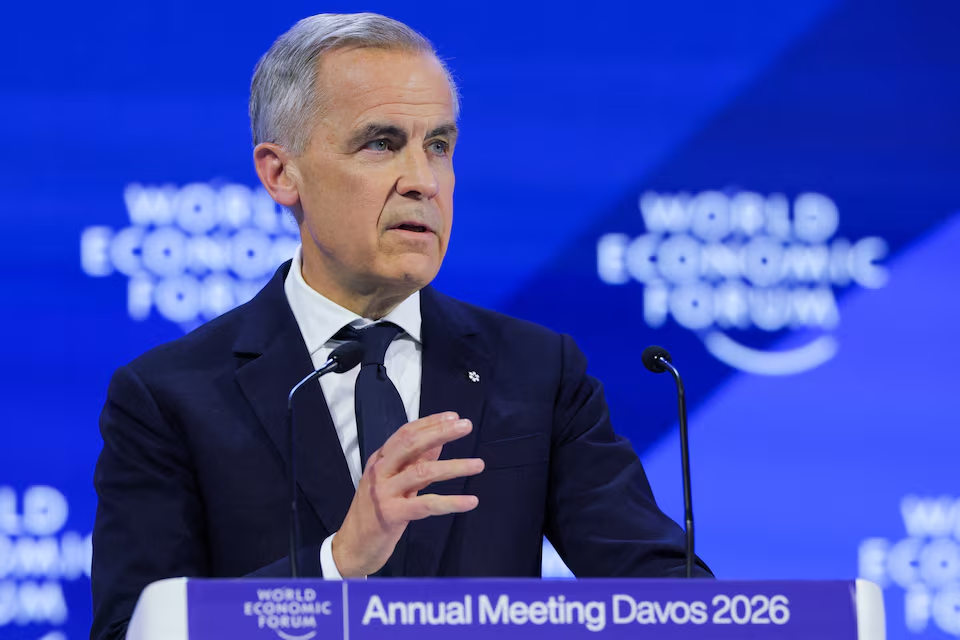
Canadian Prime Minister Mark Carney walked back comments from his Davos speech during a call with U.S. President Donald Trump, according to the U.S. Treasury Secretary. Scott Bessent stated Carney was “very aggressively walking back some of the unfortunate remarks” made last week. The Carney Davos comments had urged nations to accept the end of a rules-based global order. That speech received a rare standing ovation at the World Economic Forum. In response, Trump revoked Canada’s invitation to a “Board of Peace” and threatened 100% tariffs. The call highlights severe diplomatic tensions between the two neighbors. Carney’s office did not immediately comment on the Treasury Secretary’s characterization.
The Provocative Davos Speech
Mark Carney’s address in Davos, Switzerland, struck a defiant tone. He declared the rules-based global order finished. Carney pointed to Canada as an example for “middle powers.” He argued such nations must act together to avoid being victimized by American hegemony. The Prime Minister did not name Trump or the U.S. directly. However, his message was clear to the audience of world leaders and executives. His remark that “if you are not at the table, you are on the menu” resonated widely. The speech received a rare standing ovation, signaling approval from many global elites. This public challenge triggered an immediate and aggressive response from Washington.
Trump’s Retaliation and Tariff Threat
President Trump reacted swiftly to the Carney Davos comments. He first revoked Canada’s invitation to join a proposed “Board of Peace.” This foreign policy initiative aims to resolve global conflicts, according to Trump. Then, on Saturday, the President issued a stark economic threat. He warned of imposing a 100% tariff on Canadian goods if Ottawa proceeded with a trade deal with China. Carney had just returned from a trip to Beijing, where he reset strained relations and secured a trade agreement. China is Canada’s second-largest trading partner after the United States. The tariff threat represents a severe escalation in bilateral trade tensions.
The Damage Control Call and Its Aftermath
The reported call between Carney and Trump occurred on Monday. Treasury Secretary Scott Bessent was present in the Oval Office. He described Carney as “aggressively” walking back the Davos remarks. This suggests a forceful attempt at de-escalation by the Canadian leader. The Prime Minister’s office has not confirmed or denied Bessent’s account. The lack of immediate comment is notable. The call’s occurrence itself indicates the seriousness of the rift. Canada’s economy is deeply dependent on U.S. trade. Bessent emphasized this, stating a tariff would be “a disaster for Canada.” The episode underscores the precarious position of middle powers in the current geopolitical climate.
Broader Implications for Canada-US Relations
The incident reveals deep strains in the traditionally close alliance. Carney’s Davos speech represented a rare public critique of U.S. dominance. The forceful U.S. response reaffirmed Washington’s willingness to use economic coercion. It also highlighted the risks of Canada diversifying its trade toward China. The U.S. views such moves through a lens of strategic competition. For Canada, balancing its vital U.S. relationship with other partnerships is now exceptionally delicate. The “walk back” call may calm tensions temporarily, but underlying frictions remain. Trust between the two administrations appears significantly damaged. Future Canadian foreign policy initiatives will likely be weighed against potential U.S. reactions.
Global Reaction and the “Middle Powers” Concept
Carney’s Davos comments elevated the discourse on “middle powers.” His argument for collective action found a receptive audience among many nations. The standing ovation reflected broader global frustration with unilateral U.S. actions. However, the subsequent U.S. retaliation serves as a cautionary tale. It demonstrates the potential cost of openly challenging American hegemony. Other middle powers like Australia, South Korea, and Germany will study this episode closely. It may encourage quieter, behind-the-scenes coordination rather than public declarations. The concept of a coalition of middle powers remains viable, but its public articulation carries significant risk.
Economic Stakes and the China Trade Deal
The core U.S. grievance appears to be Canada’s renewed trade outreach to China. Carney’s trip sought to repair a relationship damaged by past diplomatic spats. A new trade deal could reduce Canadian reliance on the U.S. market. From Washington’s perspective, this aligns Canada with a strategic rival. The threat of 100% tariffs is an extreme measure meant to deter this pivot. For Canada, the China deal offers diversification but at a high potential cost. The economic calculus is now intensely political. Ottawa must decide if the benefits of the China agreement outweigh the certain wrath of its southern neighbor. This puts Carney’s government in a extremely difficult position.
The confrontation over the Carney Davos comments has escalated into a major diplomatic crisis. The Prime Minister’s attempted walk-back shows recognition of the severe economic stakes. However, the genie of public dissent against U.S. hegemony is now out of the bottle. The episode will likely make Canada more cautious in its foreign policy rhetoric. Yet, it also validates Carney’s original point about the vulnerability of middle powers. The coming weeks will test whether a truce can hold and if the China trade deal proceeds. The fundamental tension between Canadian sovereignty and U.S. economic dominance remains unresolved. This incident may be a defining moment in the bilateral relationship for years to come.